Technology
NERV is a non-rules-based AI system that learns the structure of data itself to detect, reconcile, and explain inconsistencies across complex, fragmented datasets.
What does Nerv do?
- Identifies patterns and commonalities across fragmented data
- Detects and resolves inconsistencies across multiple databases, including conflicting values for the same reference data
- Safeguards data integrity and proper use, supporting security, usability, and regulatory compliance
- Business users define confidence thresholds for data quality
- Ranking operates on a spectrum, identifying standard, outliers, and anomalies
- Mitigates dirty data and homogenizes datasets using adaptive algorithms aligned to company-specific data handling rules
- The observation compiler ensures consistency of sourced data from various formats, including PDF, URL, database, Excel, JSON, XML, etc.
- NERV can integrate applications required by the organization and can create a compiler for non-standard data types.
- Data is memory-bound.
- Volatile memory.
How Core Works
Observation Compiler
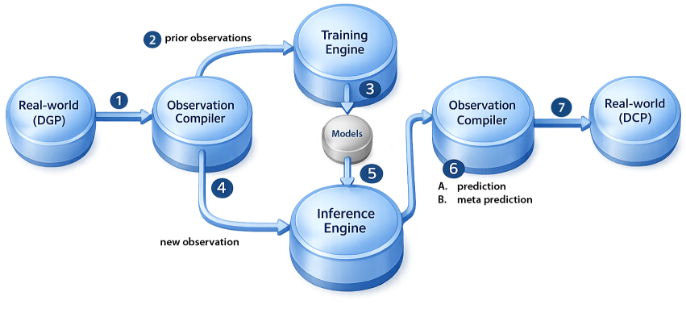
NERV handles many different instantiations and many different DGPs (for example, UCI, US Census, Yahoo, SEC, etc.). The observation compiler interfaces with the real world.
Inference Engine
Training Engine
Observations are clustered on the manifold and ranked by frequency, where observations closer to the centroid are ranked higher than cluster members.
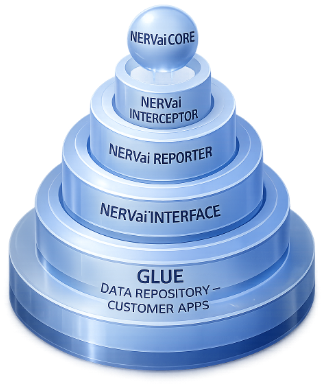
NERVCORE is an inference engine with an advanced generalizer, an observation compiler, and an AI facilitated Training Engine
The NERV INTERCEPTOR observes and compiles data; reviews and reports anomalies.
The NERV REPORTER is the native AI report generator.
The NERV INTERFACE sits outside the Core and is post report generation tool.
Glue contains business rules defined by the organization
Can map to needed applications
Reports can be generated for specific times or business indicated protocols
NERV INTERFACE to External Report Writer is used on the fly to create interactive visualizations
NERV Internal Data Model is Two-Tuple: real-state with Real: an observed value, if any, and State: a Fuzzy, linguistic indicator.
The State Spectrum conditions inference with fuzzy control logic (FCL) and with 257 levels of “present.”
Predictions are encoded to real-state space by the Observation Compiler; and are decoded back to real space by Observation Compiler. The encoding may or may not have missings; i.e., Elements won’t be novel…Composite may be novel.
Meta-Predictions are based on quality control scores of Freshness of data, Outlier vote, relevance or confidence, and Lag.
NERV Explain is an observation based on empirical similarity with respect to the model. While the best explanation is always the observation itself, there are also often many alternative, inferior explanations. An explanation can also be ranked numerically by its relevance, that is, a confidence measure.
Relevance is measured in two ways using abduction: how observation relates to model and how prediction relates to model: i.e., predicted relevance >new relevance or error -𝝰 relevance.